VALORANT Champions Shanghai group stage delivers the full Day 8 picture with every elimination and upset mapped out
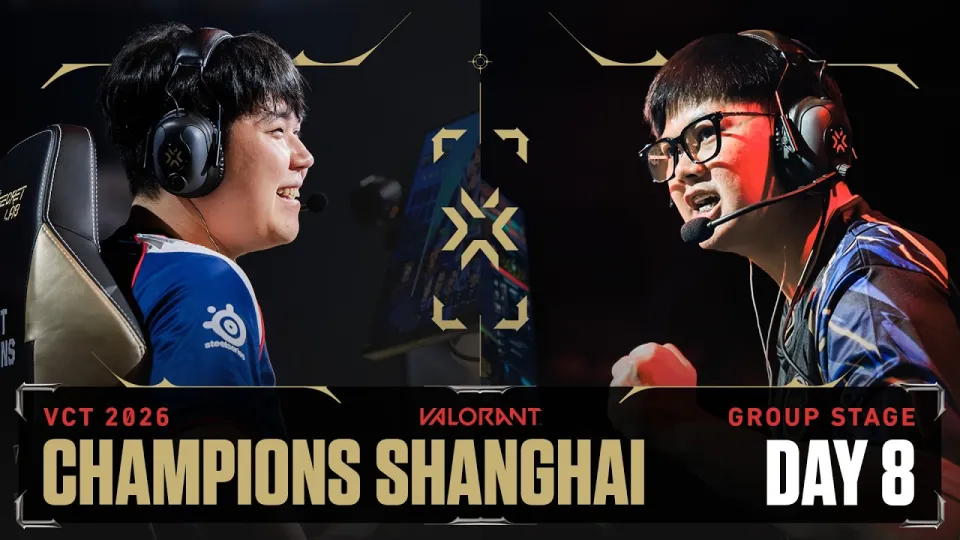
Video: VALORANT Champions Shanghai — Group Stage — Day 8
Need articles like this for your video? They help promote it on YouTube and Google — order them in the Telegram bot @sat_sit_bot. Articles with your video embedded are written and posted by the bot itself — on popular topical sites (no ads). Free trial — 50 articles.
· based on the channel VALORANT Champions Tour
VALORANT Champions Shanghai is the 2026 world championship, where sixteen teams from the Americas, CN, EMEA and Pacific converge on one bracket after a season in which Masters crowned a new champion twice. Day 8 of the group stage, broadcast by the VALORANT Champions Tour, settled two series and effectively closed the door on an entire region's playoff hopes. For live scores, bracket updates and official announcements, the fastest source is the official VALORANT Esports account on X, which posts results and schedule changes as they happen.
The day mattered because the group stage is where the format stops forgiving. Sixteen teams enter, and only a fraction leave Shanghai with a playoff slot. Day 8 turned that arithmetic into something concrete: one series ended in a single map, another needed all three, and the results pushed a whole region out of the tournament.
What Day 8 of the VALORANT Champions Shanghai group stage actually decided
Day 8 delivered two series with very different shapes. The first closed out in a single map, a quick, one-sided result that left little room for debate. The second, T1 versus JD Gaming, ran the full three maps and became the most discussed match of the broadcast.
The structure of the day is worth noting for anyone following the VOD:
- Game 1 of the broadcast opened the day and ended inside one map.
- A technical pause interrupted play between 1:15:49 and 1:16:51.
- Game 2 began after the pause and set up the T1 vs JD Gaming series.
- That series ran three maps, with the third map deciding the outcome.
For viewers catching up, the pacing is unusual: the first series is over quickly, then the broadcast settles into a long, grinding three-map affair that carries most of the day's stakes.
JD Gaming's 6-11 lead and the map that got away
The defining moment of Day 8 was JD Gaming's failure to convert a 6-11 lead on map one against T1. Losing that map flipped the entire series, because a 2-0 sweep was on the table and the third map never should have been necessary.
That collapse is the reason the match is remembered as a near-miss rather than a routine loss. Holding a five-round cushion deep into a map is a position most teams close out, and against an international opponent it would have been an outlier result for a Chinese roster at a global event. Instead, the lead evaporated, the series stretched, and the third map went the other way.
The pattern repeats a theme from the group stage as a whole: CN teams showed they could build leads against top-tier opposition but struggled to finish maps under pressure. The mechanical and tactical gap is narrower than results suggest; the closing gap is where the series were lost.
Why all four Chinese teams left Shanghai before the playoffs
Every Chinese representative at Champions Shanghai was eliminated in the group stage. That outcome dominated reaction to the broadcast and reframed how the event's format is discussed.
Two competing explanations circulated among viewers. The first is a "regional curse" — the idea that CN teams simply cannot perform at home. The second, and the more defensible one, is that home pressure is not the problem; the problem is that the rest of the world arrived better prepared. Most teams perform at or above their baseline on home soil. The Chinese squads were not outplayed by the venue, they were outplayed by opponents who had spent the season adapting to a faster, more punishing international meta.
The format question follows from that. CN teams receive direct slots into VCT events, and when all of them exit at the group stage, the argument for merging the region back into a broader APAC pool resurfaces. It is a structural debate, not a talent one, and it will not be settled by a single tournament.
T1, Munchkin on a duelist and the team-building questions
T1's win came with a roster decision that drew immediate attention: Munchkin was fielded on a duelist. Munchkin's reputation is built on flexible, utility-heavy play rather than entry fragging, so moving him onto a duelist changes how the team takes space and who is expected to open sites.
That choice is not automatically wrong. Duelist picks in 2026 are less about raw aim and more about timing, trade structure and how a team wants to force engagements. Putting a smart, adaptable player on a duelist can work if the composition is built around delayed entries and heavy utility support. But it shifts pressure onto the rest of the roster, and it makes the team's defaults easier to read.
Against JD Gaming it worked out. The larger question is whether it holds against playoff-caliber opponents who will punish a predictable entry pattern. Day 8 gave T1 the win and a template; the bracket will decide whether the template survives.
Viewer questions that shaped the Day 8 conversation
Day 8 produced a cluster of recurring questions in the broadcast chat, and they point at real gaps in how the event is presented and how the game reads on stream.
Technical pauses and pacing. The pause between 1:15:49 and 1:16:51 broke the flow of the first series. Long pauses are common in international events, but they hit harder when a series is already one-sided.
Hit registration on stream. A clip around 3:23:18 showed what looked like three bullets connecting with Omen while the HUD registered only two. This is a recurring complaint in any FPS broadcast, and the usual causes are spectator-side interpolation, server tick behavior and how damage numbers are rendered for viewers rather than players. It is rarely a clean proof of a bug.
Crowd atmosphere. Multiple viewers compared the venue to a library. Crowd noise at CN events has been a talking point all season, and the broadcast mix heavily influences how loud a crowd sounds on stream.
Broadcast talent. The casting pair drew positive reactions, which matters for a day whose second series ran long.
A silenced Crown. One of the most-liked comments of the day singled out a Crown ultimate being silenced as the most satisfying moment of the match — a small mechanical detail that decided a round and, arguably, momentum.
How the group stage result reshapes the Shanghai bracket
With the group stage resolved, the playoff bracket is set by seeding rather than reputation. Teams that survived did so on map conversion, not on highlights.
Three takeaways carry into the playoffs:
- Closing maps is the single biggest separator at this event. JD Gaming's 6-11 loss is the clearest example.
- Roster flexibility wins series. T1's willingness to move Munchkin onto a duelist gave them options JD Gaming could not match on the third map.
- Regional depth is not the same as regional top-end strength. CN's four eliminations say more about preparation and closing than about raw skill.
For teams still alive, the lesson is unglamorous: protect leads, convert map points, and do not let a series reach a third map against an opponent with better mid-round adjustments.
Useful links
- Official VALORANT Esports on X: https://x.com/valorantesports
- Facebook: https://www.facebook.com/ValorantEsports/
- Instagram: https://www.instagram.com/valorantesports/
- TikTok: https://www.tiktok.com/@valorantesports
- Twitch: https://www.twitch.tv/valorant
The Day 8 verdict
Day 8 of the group stage was less about spectacle and more about consequence. JD Gaming's inability to close a 6-11 map turned a potential statement win into an early exit, T1 advanced on the back of a roster decision that raised eyebrows and worked, and the CN region left Shanghai with nothing to show for its direct slots. The broadcast, produced by the VALORANT Champions Tour, remains the best way to watch the series in full and judge the rounds that decided them. Follow the official VALORANT Esports account on X for bracket updates, schedules and results as the playoffs begin.
Key takeaways
- Sixteen teams from Americas, CN, EMEA and Pacific contested the 2026 VALORANT world title across a tournament window running September 24 to October 18.
- Day 8 featured two series: an opening game decided in a single map and the T1 vs JD Gaming clash that went the full three maps.
- JD Gaming led 6-11 on map one and lost it, a throw that viewers treated as the difference between a 2-0 and elimination.
- All four Chinese representatives were eliminated in the group stage, which reshaped the playoff seeding.
- A technical pause interrupted the broadcast between 1:15:49 and 1:16:51, and Munchkin was fielded on a duelist.
- Shanghai 2026 is the culmination of a season in which Masters produced a new champion twice, breaking the old regional hierarchy.
Source: VALORANT Champions Shanghai — Group Stage — Day 8 · Markdown version
Questions & answers
Did JD Gaming really have a 2-0 chance against T1 on Day 8?
Yes. JD Gaming held a 6-11 lead on map one and lost it, which forced the series to a third map. Winning that map would have put them one map from a 2-0 sweep. Instead, the series went the distance and T1 took it, making the map-one collapse the decisive moment of the day.
Why were all four Chinese teams eliminated in the group stage?
The results point to closing ability rather than a home-venue curse. Most teams perform at or above their normal level on home soil, and CN squads built leads against international opponents but failed to convert them. Preparation and mid-round adjustments against the global meta were the bigger factors.
Was the Munchkin duelist pick a mistake for T1?
It worked against JD Gaming, but it changes how T1 takes space and who is expected to open sites. Munchkin's strength is flexible, utility-heavy play, so putting him on a duelist shifts pressure onto the rest of the roster and makes defaults easier to read. Playoff opponents will test whether the composition holds up.
Why did the broadcast show two damage numbers when three bullets appeared to hit?
Spectator-side rendering is not the same as what the server registers. Interpolation, tick rate and how damage is displayed to viewers can all make a hit look unregistered. Clips like the one around 3:23:18 are common in FPS broadcasts and rarely prove an actual hit-registration bug.